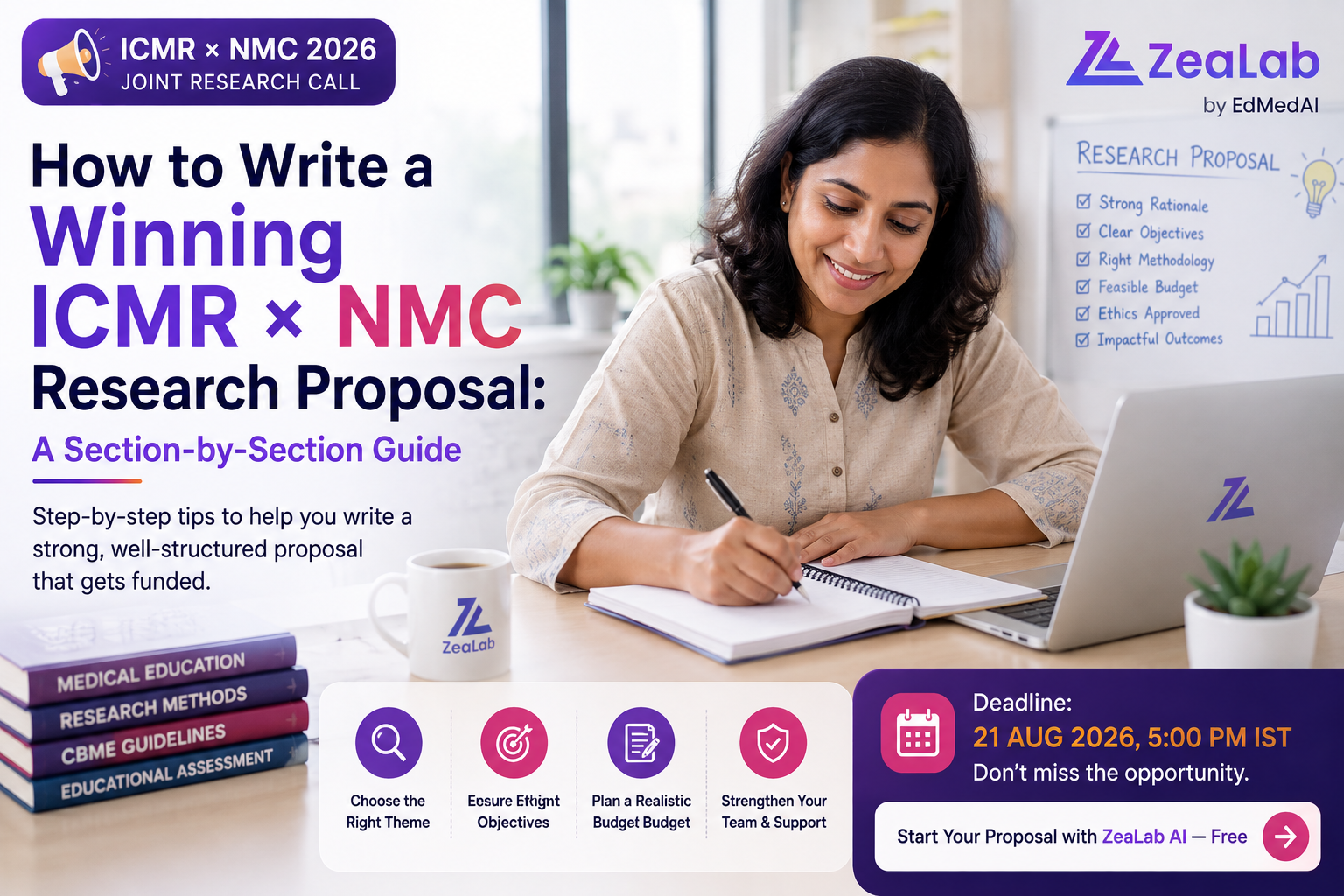
A Strong Proposal Starts With a Strong Research Question
A good research proposal does not begin with the application form. It begins with a problem worth investigating.
Many faculty members identify meaningful problems in teaching, assessment, and student learning. The challenge is turning those observations into a focused research question and a proposal that is scientifically sound and feasible.
For the ICMR × NMC 2026 research call, I recommend focusing on eight areas.
If you are still exploring the ICMR × NMC 2026 opportunity, start with my complete guide to the ICMR × NMC 2026 Medical Education Research Grant. It covers the eligibility criteria, grant categories, research areas, submission requirements, and key dates. Once you understand the call, this guide will help you build a stronger proposal.
01 — Choose a Problem You Understand
Choose a research theme that connects with your actual teaching or institutional experience.
Possible areas include:
- CBME implementation
- Digital and AI-enabled education
- Simulation-based training
- Assessment methods
- Faculty development
- Curriculum innovation
- Student wellbeing
- Postgraduate and rural medical education
Don’t choose a topic simply because it sounds innovative.
The strongest research questions often come from problems you have personally observed.
02 — Make Your Research Question Specific
Avoid broad titles such as the following:
A Study on Digital Tools in Medical Education
Instead, clearly define the intervention, population, and outcome.
Effectiveness of AI-Assisted Formative Assessment on CBME Competency Outcomes Among Undergraduate Medical Students
Your primary objective should be specific, measurable, and achievable within the proposed timeline.
03 — Choose the Right Study Design
Your methodology should answer your research question—not make the proposal sound more complicated.
Depending on the question, you may consider the following:
- Randomized or quasi-experimental studies
- Cohort or observational studies
- Mixed-methods research
- Qualitative studies
- Implementation research
- Educational action research
- Systematic reviews or meta-analyses
Don’t propose an RCT if your institution cannot realistically execute one.
A scientifically appropriate and feasible study is stronger than an ambitious but impractical design.
04 — Build the Rationale Around the Research Gap
Your background should answer four questions:
What is the problem?
Use credible evidence to establish it.
Why does it matter?
Explain its impact on learners, educators, patients, or the healthcare system.
What is missing?
Identify the research gap.
What will your study add?
Explain how your research addresses that gap.
A simple structure is
Problem → Evidence → Gap → Proposed Study → Expected Contribution
Use relevant peer-reviewed and indexed literature rather than relying on blogs or unsupported claims.
05 — Start Your IEC Process Early
Ethics should not be left until the last week.
Your IEC submission should address:
- Participants and recruitment
- Informed consent
- Data privacy and confidentiality
- Data storage and access
- Anonymization
- Potential risks and benefits
The ICMR × NMC call requires IEC clearance or proof of submission, as applicable.
Start early.
06 — Make Your Budget Defensible
A good budget explains what you need and why you need it.
Depending on your study, this may include the following:
- Manpower
- Equipment
- Consumables
- Travel
- Contingency
- Institutional overheads
Every major expense should be justified and consistent with your methodology.
Avoid unnecessary equipment and inflated estimates.
Your budget should tell the same story as your research plan.
07 — Build the Right Research Team
Your PI and Co-PIs should bring the expertise required to execute the study.
Reviewers may consider:
- Research experience
- Medical education experience
- Publications
- Methodological expertise
- Relevant clinical or subject expertise
- Previous research projects
For this call, up to 3 Co-PIs can be included, with at least one Co-PI from the PI’s own institution.
Don’t add names simply to strengthen the appearance of the team.
Every Co-PI should have a clear role.
08 — Secure Institutional Support Early
Your institutional endorsement demonstrates that the college is prepared to support the proposed research.
Get the required letter from the principal, dean, or director early and ensure it clearly reflects institutional support.
Do not let administrative delays undermine a strong research proposal.
Before You Submit
Ask yourself:
- Is the research problem clearly defined?
- Is there a genuine research gap?
- Are the objectives measurable?
- Does the methodology answer the research question?
- Is the study feasible?
- Is the budget justified?
- Does the team have the required expertise?
- Has the IEC process been initiated?
- Is institutional support in place?
If the answer is yes across the board, your proposal is on much stronger ground.
Research Should Lead to Better Education
The objective of a research grant should not simply be to secure funding.
The real objective is to generate evidence that helps us teach better, assess better, and ultimately prepare better doctors.
The ICMR × NMC 2026 call provides an opportunity for medical educators to investigate the problems they encounter every day.
Start with the problem. Ask the right question. Generate the evidence.
Turn Your Research Idea Into a Strong Proposal
Build your ICMR × NMC 2026 proposal with evidence, structure, and clarity using ZeaLab AI.