Medical colleges are the primary incubators for national health innovation.
Medical education in India stands at a genuine inflection point. As our colleges adopt competency-based frameworks, expand postgraduate training, and take on a larger role in shaping healthcare delivery, research culture in medical colleges is the natural next frontier for continued progress.
Every medical college has faculty who see new challenges, test new approaches, and identify opportunities to improve learning. The opportunity now is to turn those individual efforts into a sustained culture of research.
Building a modern, technology-enabled research infrastructure within our medical institutions is the most strategic, high-yield investment to transform regional clinical insights into world-class standards of care.
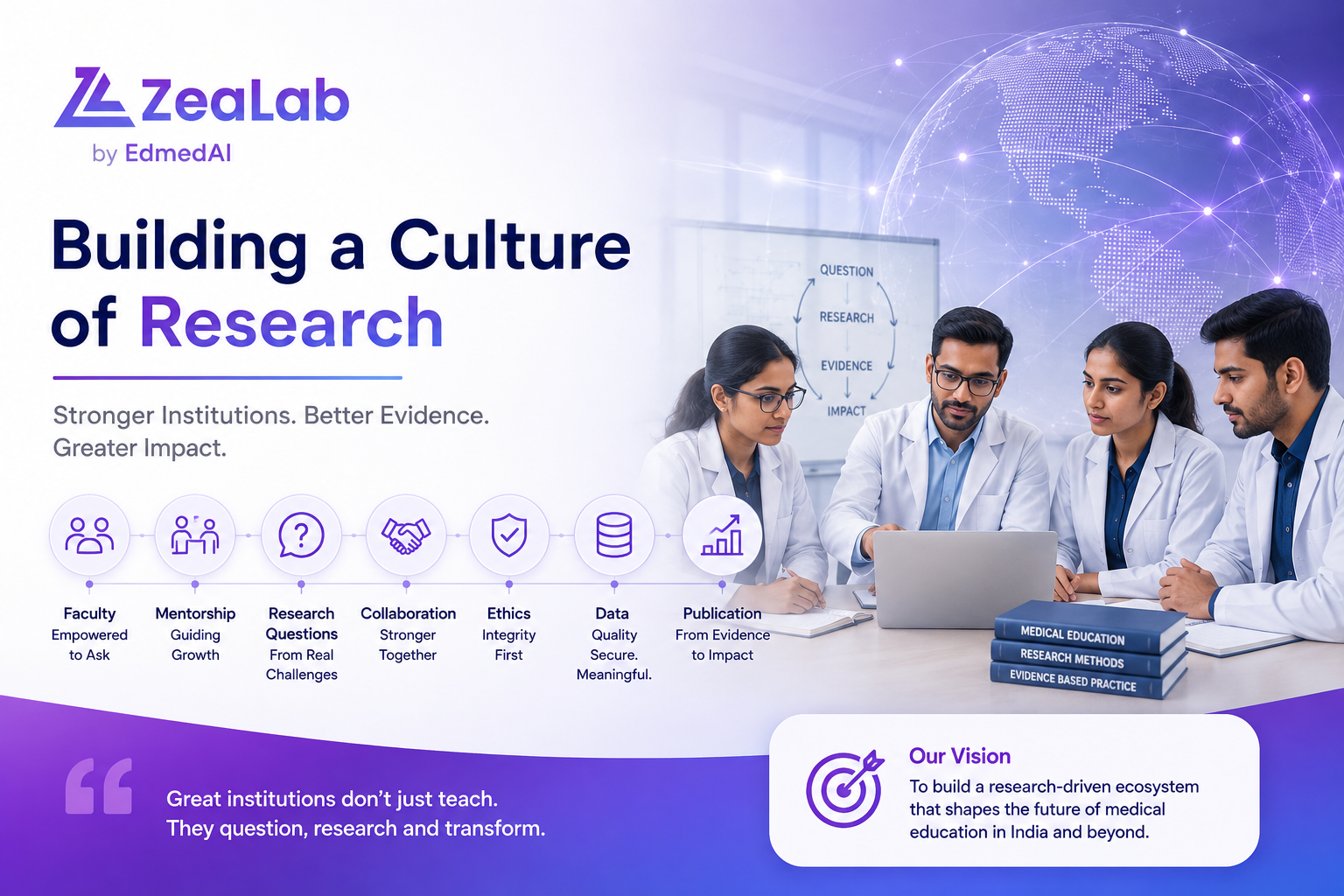
Here are the foundational pillars to build a culture of research in medical institutions:
1. Systematize Clinical Curiosity
Research must be woven into the core curriculum from day one.
- Shift the Pedagogy: Transition academic frameworks from passive memorization to active inquiry.
- Encourage Faculty: Faculty should be encouraged to look beyond established practices and ask, “What can we improve?” What evidence do we have? What should we test? A teaching challenge, competency gap, or assessment outcome can become the starting point for meaningful research.
- Provide Early Support: Institutionalize seed grants and structured mentorship during undergraduate and postgraduate training.
2. Democratize AI and Data Infrastructure
The future of medical discovery is undeniably data-driven. To build an enduring research ecosystem, leadership must provide modern digital infrastructure.
- Deploy AI Tools: Integrate multi-agentic AI models and advanced decision-support platforms directly into everyday clinical workflows.
- Leverage Interoperable EMRs: Ensure electronic medical record systems securely capture structured clinical data.
- Translate Data into Insights: Allow students and faculty to seamlessly transform routine clinical encounters into population-level epidemiological studies and real-world evidence (RWE).
3. Realign Institutional Incentives
Overworked clinicians cannot produce high-impact research without structural operational support.
- Protect Faculty Time: Allocate dedicated clinical hours explicitly for research and grant writing.
- Reward Innovation: Modernize academic career progression to reward collaborative innovation, cross-disciplinary patents, and clinical application.
4. Build Global Networks
Isolated academic inquiry is no longer sufficient. Modern medical colleges must operate as interconnected nodes within a global healthcare network.
- Foster Public-Private Partnerships: Collaborate with biotechnology firms, health-tech startups, and governmental bodies to accelerate translational research.
- Connect Local Wards to Global Registries: Link local clinical data with international research consortia to turn regional health observations into global treatment standards.
- Drive Cross-Border Faculty Exchange: Establish international research fellowships that bring global best practices back to local institutions.
5. Publication Support
Finishing a study and publishing it are two different disciplines, and the second one is where many first-time researchers lose momentum. Writing support, realistic timelines, and someone senior reviewing a draft before submission make the difference between a study that ends in a drawer and one that ends in a journal. This last mile deserves as much institutional attention as the first.
The Vision Ahead
The long-term goal is to create a generation of medical educators who are not only teachers and clinicians but also researchers, innovators, and evidence-driven leaders—and institutions capable of contributing solutions that matter at the national and global level.
By embedding a structured, technology-enabled research culture today, we ensure our faculty and graduates have the exact tools needed to cure the diseases we currently cannot.
The future of medicine is exceptionally bright—and it begins in our classrooms, wards, and laboratories.